|
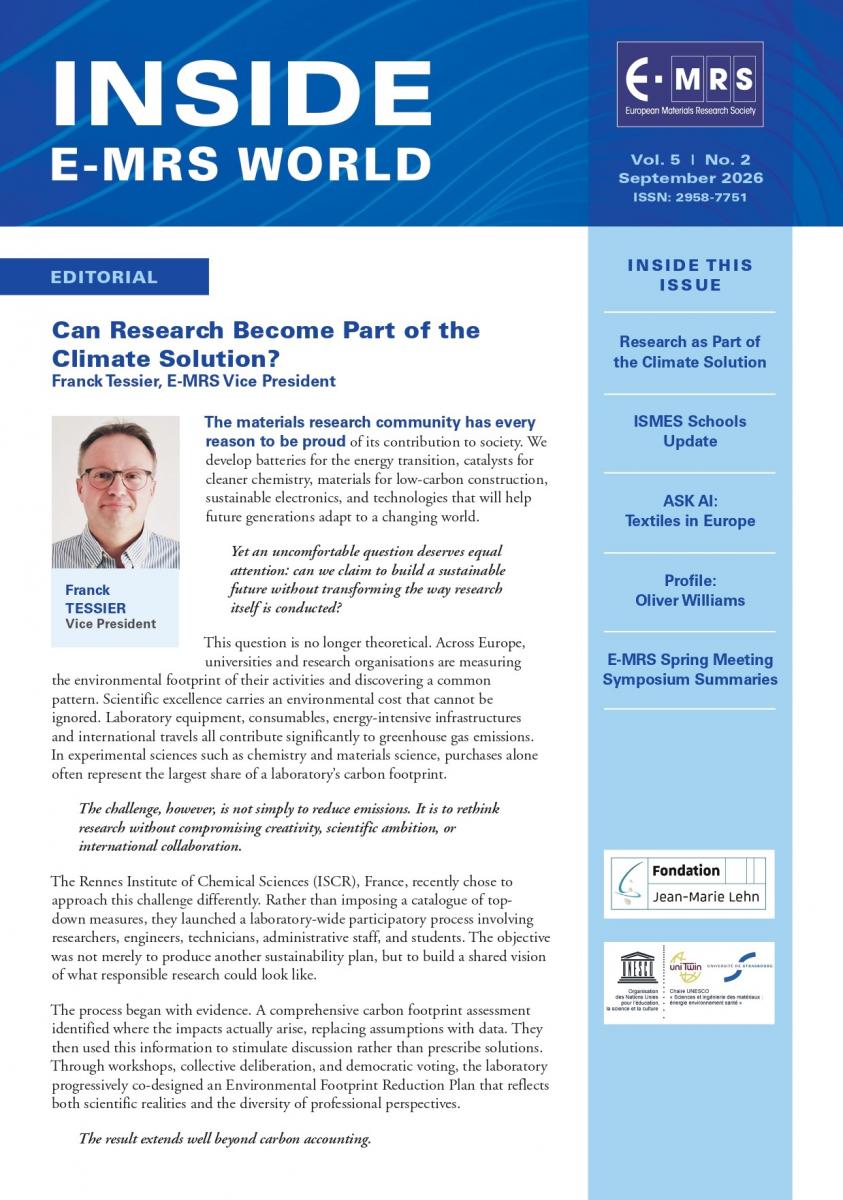
The materials research community has every reason to be proud of its contribution to society.
We develop batteries for the energy transition, catalysts for cleaner chemistry, materials for
low-carbon construction, sustainable electronics, and technologies that will help future generations
adapt to a changing world.
Yet an uncomfortable question deserves equal attention: can we claim to build a
sustainable future without transforming the way research itself is conducted?
This question is no longer theoretical. Across Europe, universities and research organisations are
measuring the environmental footprint of their activities and discovering a common pattern.
Scientific excellence carries an environmental cost that cannot be ignored. Laboratory equipment,
consumables, energy-intensive infrastructures and international travels all contribute significantly
to greenhouse gas emissions. In experimental sciences such as chemistry and materials science,
purchases alone often represent the largest share of a laboratory’s carbon footprint.
The challenge, however, is not simply to reduce emissions. It is to rethink research without
compromising creativity, scientific ambition, or international collaboration.
The Rennes Institute of Chemical Sciences (ISCR), France, recently chose to approach this
challenge differently. Rather than imposing a catalogue of topdown measures, they launched
a laboratory-wide participatory process involving researchers, engineers, technicians, administrative
staff, and students. The objective was not merely to produce another sustainability plan, but to build
a shared vision of what responsible research could look like.
The process began with evidence. A comprehensive carbon footprint assessment identified where
the impacts actually arise, replacing assumptions with data. They then used this information to
stimulate discussion rather than prescribe solutions. Through workshops, collective deliberation,
and democratic voting, the laboratory progressively co-designed an Environmental Footprint
Reduction Plan that reflects both scientific realities and the diversity of professional perspectives.
The result extends well beyond carbon accounting (...)
|